Welcome to the Baseball AI Workbench
The AI Learning Workbench is an interactive web application. Explore various analytics, decision intelligence & Machine Intelligence techniques using historical baseball data.
Available Scenarios:

What-If Analysis - Rules Engine
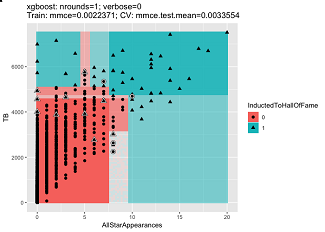
This scenario showcases how a simple rules engine can be used to attempt to predict baseball Hall Of Fame Induction.
No Machine Intelligence is used, rather a simple rule:
If sum of career HRs >= 500 then Hall of Fame Induction is True (else Hall of Fame Induction is False).
What-If Analysis - Single Model
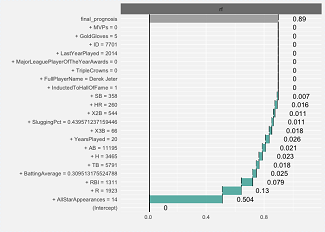
This scenario showcases how a Machine Intelligence model can be used to predict baseball Hall Of Fame Induction.
Machine Intelligence is used to build statistical signals over batter baseball statistics.
The key difference over the rules engine approach is that a probability is returned; allowing a decision to be executed using probabilistic decision threshold.
What-If Analysis - Multiple Models
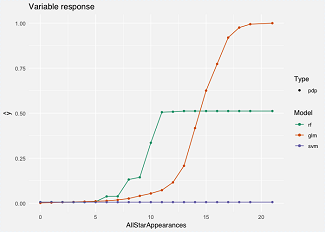
This scenario showcases how multiple Machine Intelligence models can be used to predict Hall Of Fame BallotPresence & Hall Of Fame Induction.
Machine Intelligence is used to build statistical signals over batter baseball statistics.
The multiple models implementation showcases breaking down the to Hall of Fame Induction into a process. First, the player needs to be considered on being on the Hall of Fame Ballot then considered for Hall of Fame Induction.
This can be used to aid the decision maker, by providing multiple supporting conclusions provided by Machine Intelligence (experts).
What-If Analysis - Agentic Analysis This scenario uses multiple AI agents to assess Hall of Fame Ballot Presence and Induction using player statistics, machine learning predictions, and retrieved professional commentary. Quantitative evidence comes from the selected player’s batting statistics and probabilities calculated by multiple machine learning models. Agent Q combines the agents’ assessments into probability estimates and sensitivity ranges.
Machine Learning Probability Statement characteristics:
- Baseball data used: MLB batter data aggregated at the season level from 1876 to 2024. (Note: Only players that were predominantly position players are included, pitchers data has been omitted.)
- The prediction of Hall of Fame Ballot Presence or Induction is surfaced as a probability percentage between 0% and 100%.
- Hall of Fame Ballot Presence is defined as the presence of the candidate batter on any of the yearly vote total for the Hall of Fame.
- Hall of Fame Induction is defined as the candidate achieving 75% of the necessary vote by the BWAA electors or special BWAA sessions. Note: This explicitly excludes candidates in the Hall of Fame sent in by other means (i.e. veteran's comittee). More info: https://baseballhall.org/hall-of-famers/rules/bbwaa-rules-for-election
- The machine learning models have been built using the Generalized Additive Models (GAM) algorithm using ML.NET.
- The following batting features were used to build the ML models: Years Played, At Bats, Runs, Hits, Doubles, Triples, Home Runs, RBIs, Stolen Bases, Batting Average, Slugging Percentage, All-Star Appearances, MVPs, Triple Crowns, Gold Gloves, Total Bases, Total Player Awards.